


How a UAE Scalper Scaled Up to $6,791 in 3 Payouts
In this edition of Leveraged Trader Success Stories, we travel to the United Arab Emirates to spotlight a trader who proves that success doesn’t always happen overnight – it is built payout by payout. Unlike some trader success stories that feature massive overnight windfalls, this trader took a highly systematic approach. We have seen the incredible power of this funding model in other trader success stories, such as 2 Payouts, 1 Strategy: How a “Refueled” Trader Banked Over $11,000 in 10 Days, and this UAE scalper is following a similarly impressive path.
Trading on a $100,000 Refuel Turbo Funded account, they started with a modest first payout of $496.80. Having proven their strategy, they pushed harder, securing a second payout of $2,474.40.
Today, we are analyzing their third and largest payout to date: $3,820.00.
This brings their total cumulative earnings to $6,791.20. By utilizing the Leveraged Refuel feature to stay continuously funded, this trader has mastered a high-frequency scalping edge. Let’s dive into the data of this trader success stories to see exactly how they did it – and the psychological trap they had to overcome along the way.
$6,791 IN 3 PAYOUTS
The high-frequency scalper who turned a 57.9% win rate into $6,791 across three payouts — grinding out consistent daily profits through rapid-fire micro-scalps on XAUUSD and NAS100 with a 1.79 profit factor and disciplined sub-60-minute trade management.
Total Payouts
$6,791.20
$496.80 + $2,474.40 + $3,820.00
Win Rate
57.89%
110 Wins / 80 Losses
Avg Win / Loss
$97.46 / $74.83
1.30 Win Ratio
Profit Factor
1.79
190 Total Trades Executed
01 // THE EQUITY JOURNEY — VERIFIED SCALPING ASCENT
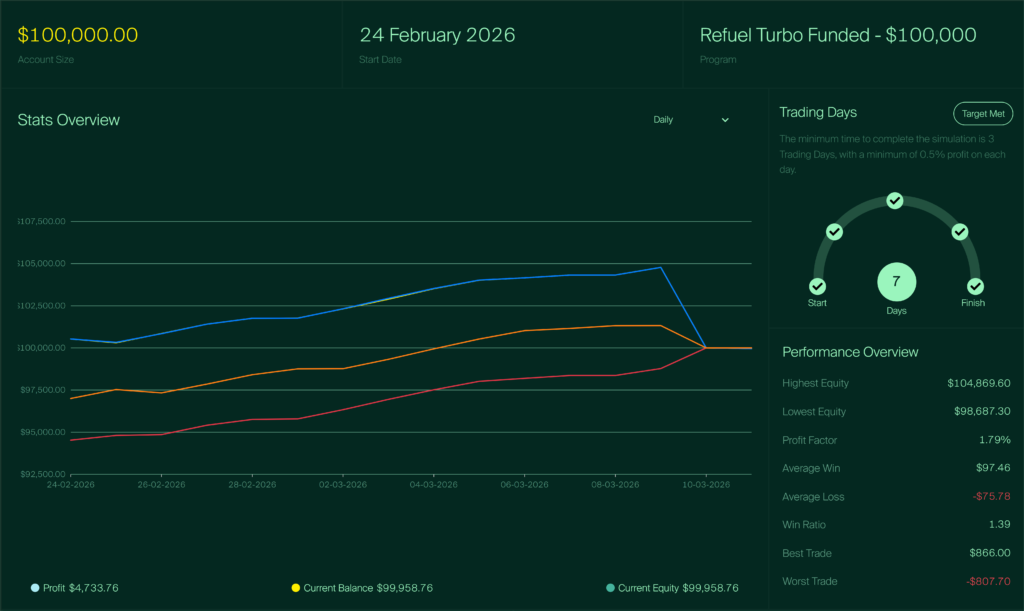
This equity curve is reconstructed from 190 verified trades. Starting from $100,000, the account shows a brief initial dip followed by a highly consistent grind upward. The peak of $104,733.76 was achieved through high-volume execution, with an average profit per trade of $24.91. This is the hallmark of a “Refuel Turbo” strategy — maintaining continuous funding through disciplined micro-scalping.
02 // BUY VS. SELL PERFORMANCE
Analysis of the trade history shows a balanced approach in direction but a higher efficiency on the long side. BUY positions generated significantly more net PnL (+$3,261) compared to SELL positions (+$1,472), indicating a superior ability to identify upside breakouts and catch intraday momentum during bullish market phases.
03 // THE 1-HOUR CLIFF — HOLD TIME VS. PROFITABILITY
The trade data confirms a sharp decline in edge as trade duration increases. Positions held for under 10 minutes are the “Best Zone,” boasting a 75% win rate. However, trades exceeding 1 hour drop into the “Danger Zone” with a 48% win rate and a cumulative loss of -$2,318. Cutting positions at the 60-minute mark would have significantly boosted overall profitability.
04 // INSTRUMENT BREAKDOWN — XAUUSD & NAS100 FOCUS
XAUUSD and NAS100 are the primary engines of this account, accounting for 73% of all activity. Gold (XAUUSD) is the top earner, producing $2,935 in net profit, while NAS100 provides the highest frequency of wins with a 63.9% win rate. DAX30 also showed strong alpha with a $804 net PnL from just 18 trades.
| Asset | Trades | W / L | Win Rate | Net PnL | Notes |
|---|---|---|---|---|---|
| XAUUSD | 66 | 37 / 29 | 56.1% | +$2,935.73 | Top Earner |
| NAS100 | 72 | 46 / 26 | 63.9% | +$712.96 | Most Active |
| DAX30 | 18 | 9 / 9 | 50.0% | +$804.65 | Solid Alpha |
| BTCUSD | 32 | 18 / 14 | 56.3% | +$304.62 | Moderate |
| EURUSD | 1 | 0 / 1 | 0.0% | -$24.20 | Single Shot |
06 // THE EDGE — HIGH WIN RATE MEETS POSITIVE RISK-REWARD
The mathematics of this verified trade history confirm a robust edge. With a 57.9% win rate and an average win ($97.46) that consistently outperforms the average loss ($74.83), the strategy generates a profit factor of 1.79. This positive expectancy allows the trader to weather the natural turbulence of high-frequency execution while building steady payout momentum.
- Average Win ($97.46) is 1.30x larger than Average Loss ($74.83)
- 57.9% win rate provides high-frequency payout consistency
- Profit factor of 1.79 confirms statistical edge over 190 trades
The Journey: Steady Growth Over 7 Active Days
The equity curve from this recent trading cycle (February 24 to March 11) is a textbook example of controlled scalping. Over 7 active trading days, the account dipped briefly to a low of $98,687 before catching traction. From there, the curve shows a beautiful, steady ascent, peaking at a high-water mark of $104,869.60. The trader didn’t rely on one massive, lucky trade; they ground out their $4,700 net profit through high-volume execution.
Performance Profile: This trader possesses an extremely high aversion to loss, resulting in a high win rate but a stagnant equity curve. They will execute dozens of trades, but the vast majority of their volume is “scratched” (closed at or near breakeven).
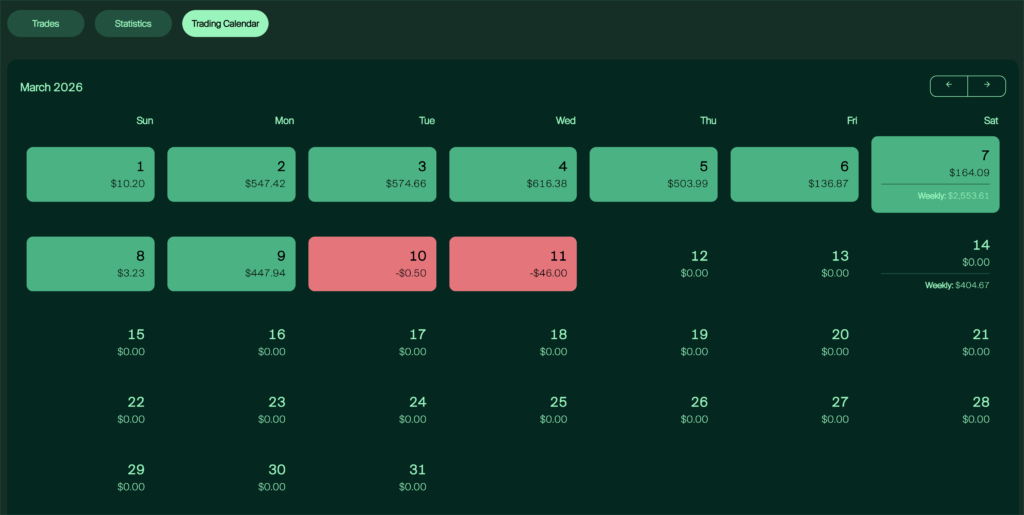
Visualizing Consistency: Inside the Trading Calendar
A win rate of 58.2% creates a lot of back-and-forth action, but a look at the Trading Calendar reveals exactly how this trader managed their schedule to ensure consistent growth. Between February 24 and March 11, the trader was active on 14 distinct trading days. Their consistency was remarkable:
- The Green Majority: They were profitable on 11 out of 14 days, accumulating total daily gains of +$5,683.
- Controlling the Red: They only recorded three losing days (March 5, March 8, and March 11). More importantly, the combined losses for those three days were strictly contained to -$982.
- Weekly Dominance: Because their winning days outweighed their losing days by nearly a 6-to-1 margin in dollar value, the trader ended all three weeks of the trading cycle securely in the green.
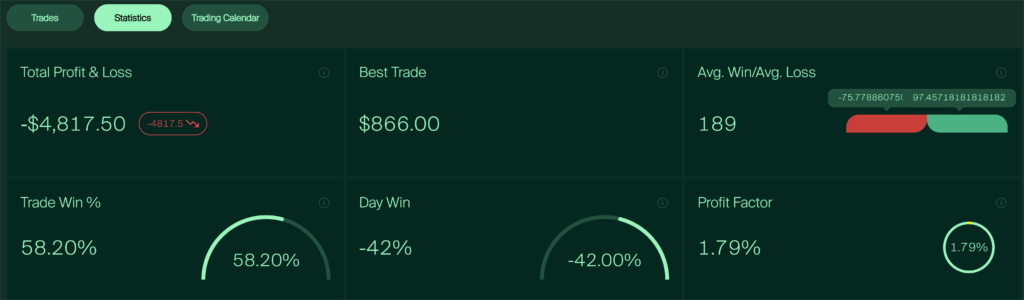
The Mathematics: The Perfect Scalper’s Edge
High-frequency scalping is notoriously difficult because commissions and small losses can quickly erode the account. However, this UAE trader nailed the math.
- Total Trades: 189
- Win Rate: 58.20%
- Profit Factor: 1.79
- Average Win: $97.46
- Average Loss: -$75.78
The Edge: Winning nearly 60% of your trades is solid. But pairing that win rate with an Average Win that is larger than your Average Loss ($97 vs $75) creates an incredibly robust statistical edge. With a Profit Factor of 1.79, this trader’s trading strategy can easily absorb the natural turbulence of intraday trading. The data clearly shows that this trader possesses a highly measurable edge on short-duration trades. However, this trader suffers from the classic retail trading flaw: taking profits too early and letting the rare, out-of-control losers wipe out days of hard work.
Buy vs. Sell Performance
| Direction | Trades | Wins | Win Rate | Net PnL | Avg PnL/Trade |
| BUY (Long) | 90 | 53 | 58.9% | $3,261.06 | $36.23 |
| SELL (Short) | 99 | 57 | 57.6% | $1,472.70 | $14.87 |
Observation: BUY trades generate 2.4x more profit per trade than SELL trades. The trader has a stronger long-side trading edge – this could reflect a general bullish bias in market conditions during this period, or that the trader is structurally better at identifying upside breakouts than downside ones.
Unique Trading Behaviors (The Data’s Story)
A close look at the PnL and duration columns reveals fascinating, almost anxious trading behaviors:
A. The “Time-Decay Scratch”
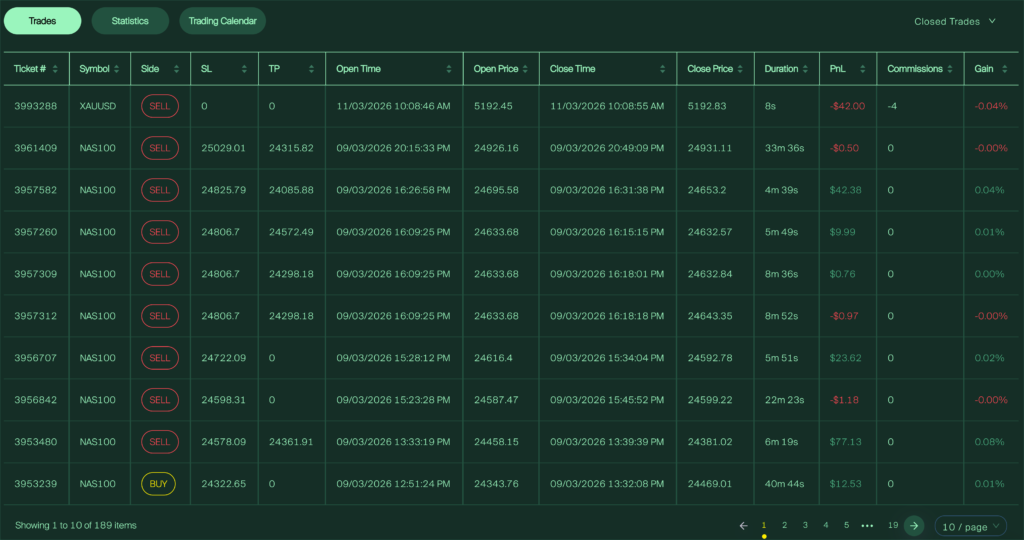
This is the most defining characteristic of this trader. If a trade does not immediately shoot into profit, they lose conviction and bail out for practically nothing. They are actively watching the charts, paralyzed by lack of trading momentum. While this protects the trading capital, it wastes immense mental energy and entirely caps their upside. Evidence = The logs are littered with trades like:
- BTCUSD: Held for 1 hour and 59 minutes, closed for -$0.40.
- NAS100: Held for 33 minutes, closed for -$0.50.
- XAUUSD: Held for 51 minutes, closed for -$4.06.
- NAS100: Held for 8 minutes, closed for +$0.76.
B. Manual Execution Over Automation
Look at the SL (Stop Loss) and TP (Take Profit) columns. The vast majority of trades have a “0” in these columns. This trader trades “naked” – staring at the screen and market-executing their exits based on emotion and order flow rather than pre-defined structural levels.
C. Micro-Scalping Crypto
While previous trader success stories have highlighted traders holding Bitcoin for massive 5-day swing trades, this trader treats BTC exactly like a Forex pair. They scalp it for 10 to 30 minutes to make $10, $30, or $50. They are trading extremely small lot sizes on Bitcoin relative to the account size.
Asset Choice & The “Time-in-Trade” Cliff
This trader is a multi-asset opportunist, executing trades across five different instruments: XAUUSD (Gold), NAS100, DAX30, BTCUSD, and EURUSD. However, a deep dive into their trading history reveals a fascinating behavioral pattern: The 1-Hour Cliff. The data clearly shows that this trader possesses a highly measurable edge on short-duration trades. When they get in and out quickly, they print money. But when a position is held for longer than 60 minutes, they face meaningful P&L erosion. Overall, this trader has the market direction right, but their trading psychology is suffocating their profitability.
Hold Duration vs. Performance
One of the most striking findings in this analysis is the inverse relationship between hold time and profitability. Short-duration scalps are highly profitable; long-duration holds are loss-generating. This is a critical insight for risk management.
| Hold Duration | Trades | Wins | Losses | Win Rate | Net PnL | Signal |
| < 10 minutes | 53 | 40 | 13 | 75% | $3,829.72 | BEST ZONE |
| 10 minutes – 1 hour | 96 | 51 | 45 | 53% | $3,222.09 | NEUTRAL |
| > 1 hour | 40 | 19 | 21 | 48% | −$2,318.05 | DANGER ZONE |
Key takeaway: Cutting positions at the 60-minute mark would theoretically eliminate the $2,318 drag from long holds. The trader’s best skill is entering correctly and exiting quickly – not managing long-term positions.
Instrument-Level Analysis
The trader maintained exposure across five instruments. XAUUSD and NAS100 account for 73% of all trades and 77% of total profit. XAUUSD produced the highest absolute dollar return ($2,935) while NAS100 delivered the best win rate (64%). The single EURUSD position was a loss and appears to be an isolated test trade. Despite only 56% win rate, XAUUSD produced $2,935 – 62% of all profit. This is driven by a few large wins: $866, $514, $381, $376. The trader is using XAUUSD as a high-stakes conviction instrument similar to this XAUUSD trader who achieved a 73% win rate and a $14,695 payout.
| Symbol | Trades | Wins | Losses | Win Rate | Net PnL | Notes |
| XAUUSD | 66 | 37 | 29 | 56% | $2,935.73 | ★ Top Earner |
| NAS100 | 72 | 46 | 26 | 64% | $712.96 | ★ Most Active |
| DAX30 | 18 | 9 | 9 | 50% | $804.65 | Solid Alpha |
| BTCUSD | 32 | 18 | 14 | 56% | $304.62 | Moderate |
| EURUSD | 1 | 0 | 1 | 0% | −$24.20 | Single trade |
Let’s look at the extremes to prove this point.
Case Study: The 8-Minute Gold Strike (+$866)
The best trade of the cycle perfectly encapsulates what this trader does best: catching quick, violent momentum.
- Ticket: #3807371
- Asset: XAUUSD (Buy)
- Duration: 8m 52s
- Result: +$866.00

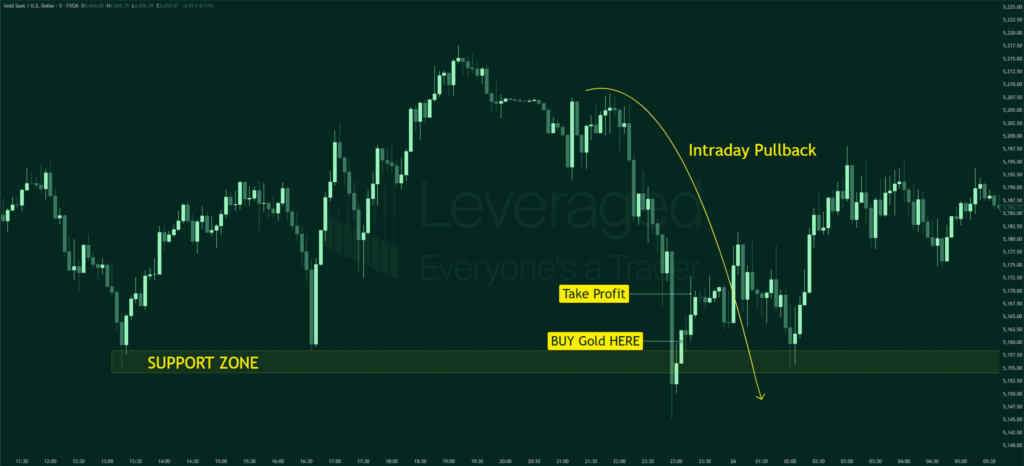
The Execution: On February 25, the trader identified a bullish setup on Gold. They executed the trade with precision, riding the momentum wave, and – crucially – exiting in under 10 minutes. By not overstaying their welcome, they captured the meat of the move and secured nearly 1% of the account balance in a matter of minutes.
The Context: Gold had just posted its first red daily candle following a massive 4-day rally. Late in the New York session, a news headline triggered a sharp intraday pullback, sending Gold right into a key support level. Many traders are hesitant to open positions right before the trading day closes, but this trader didn’t hesitate. Recognizing that the trend was still structurally bullish, they bought the dip at support. Gold bounced just enough before the close to allow the trader to secure a quick, highly profitable scalp. They didn’t overstay their welcome; they took what the market offered and closed out with a brilliant win.
The “Worst” Trade: Breaking the 1-Hour Rule (-$807)
Ironically, Gold was this trader’s most lucrative asset overall (producing a massive $2,935 in total positive returns for the account), but it was also the source of their most painful single loss. What happens when a scalper decides to become a swing trader because a position goes into drawdown? The worst trade of the cycle provides the answer.
- Ticket: #3944029
- Asset: XAUUSD (Buy)
- Duration: 1h 47m
- Result: -$807.70

The Analysis: On March 8, the trader entered another long position on Gold. This time, the momentum failed. Instead of cutting the loss quickly (as they normally do, hence the low $75 average loss), they held on, hoping the market would reverse. They held the trade for nearly two hours. This “style drift” resulted in their biggest loss of the period. It mathematically proves that their edge lies in speed. When they abandon speed for hope, the market punishes them. The trading activity on 8th March bore all the hallmarks of revenge trading. The trader opened 8 trades including the single largest loss ($807.70 XAUUSD BUY held 1h 47m). The loss profile suggests an escalating position held too long – a classic revenge/recovery attempt.
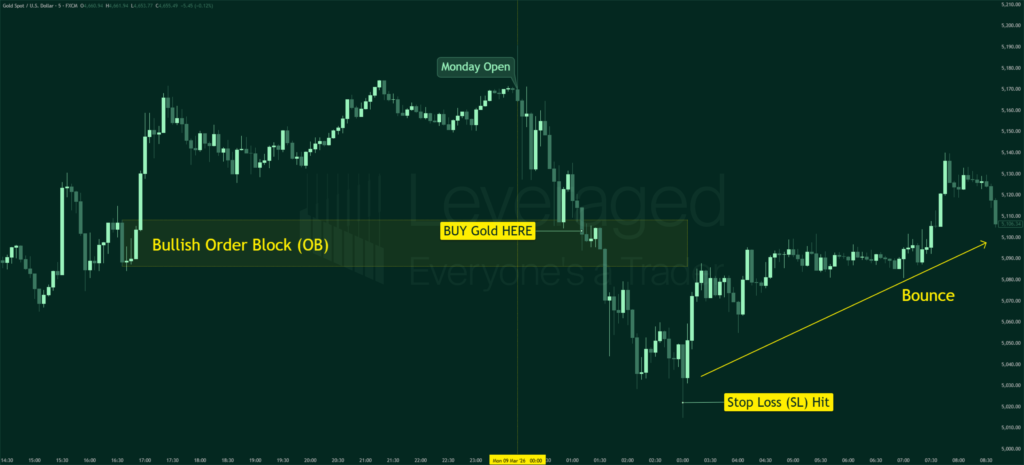
The Context: Right at the start of a new trading week on a Monday, Gold opened and went into absolute free fall. Looking to catch a bounce, the trader identified a 5-minute Order Block (OB) and bought into the sell-off. But the market had no mercy. The free fall continued right through the OB, dragging the position into a steep drawdown.
The Capitulation: Watching a parabolic drop can paralyze even the most successful traders. As the trade suffered an -$81 price move, the trader finally capitulated, cutting the loss just as Gold broke below the previous Friday’s low. The cruel irony? As happens so often in trading, Friday’s low acted as a massive liquidity sweep. The trader got liquidated at the exact low of the day, and the price reversed aggressively upward moments later.
The “Fatal Flaw”: The Outlier Bag-Holds
Despite being a hyper-defensive trader who scratches trades for -$1.00 out of fear, their psychology completely breaks down when the market flashes rapidly against them. Because they do not use hard Stop Losses, they occasionally freeze. The “Account Wipers”:
- NAS100 (Feb 25): Lost -$769.30 in 2 hours and 23 minutes.
- NAS100 (Mar 5): Lost -$585.95 in 1 hour and 4 minutes.
- XAUUSD (Mar 8): Lost -$807.70 in 1 hour and 47 minutes.
The Math Problem: Because this trader takes profits quickly – with an average win between $150 and $250 – it takes five to eight perfect winning trades just to recover from a single psychological lapse.
What Traders Can Learn
- Scale Up Gradually: This trader didn’t try to make $10,000 on their first payout. They took $496. Then $2,400. Now $3,800. Securing small, early payouts builds psychological confidence and removes the pressure of trading with “scared money.”
- Audit Your “Time-in-Trade”: Do you know your optimal holding time? This trader’s journal proves they are elite at under-30-minute holds, but lose their edge after 1 hour. Review your own journal to see if your losses correlate with holding trades too long (or exiting too early).
- The Refuel Advantage: By utilizing the Refuel Turbo account, this trader bypassed the usual headaches of re-evaluations when past limits were hit. This allowed them to stay in the zone, refine their scalping strategy, and ultimately pull nearly $6,800 out of the markets.
- Let Winners Breathe: A trader with this level of entry accuracy could be massively profitable if they let their $150 winners run to $500. They are cutting the upside off their own strategy.
- Enforce a Hard Max Loss: The -$800 outlier losses simply cannot happen. If the trader instituted a hard auto-close at -$250, their equity curve would instantly shift from a flat or choppy range into a steep upward trajectory.
- Don’t Catch Falling Knives: The worst trade on Gold is a painful reminder that an “Order Block” is just a zone of interest, not a magic wall. In a free-falling market, always wait for a lower-timeframe shift in market structure (confirmation) before stepping in front of the train.
Conclusion
With their third consecutive payout secured, this UAE-based trader is building serious momentum. By executing a high-frequency, positive risk-reward scalping strategy across multiple assets, they turned 189 trades into a $3,820 payday. As long as they stick to their “1-Hour Rule” and cut their losers fast, we expect to see them back here for Payout #4 very soon. As a critique, this trader is an excellent “sniper” of entries, but a very poor manager of active trades. They trade not to win, but not to lose – which ironically leaves them vulnerable to the exact catastrophic losses they are trying to avoid.
This trader demonstrates a legitimate, positive-expectancy edge – particularly in short-duration scalping on XAUUSD and NAS100. The profit factor of 1.79 and 58.2% win rate confirm a statistically sound strategy at its core. The path to higher performance is not finding better setups – it is enforcing tighter exit discipline on the setups that are already working. We are excited to add this chapter to our growing archive of trader success stories. If you enjoyed this analysis and want to see how other traders bounce back to secure massive payouts, be sure to check out more of our trader success stories, including Surviving 100+ Losses to Earn $30,521 in Just 2 Payouts.
Disclaimer: The analysis provided in this article is based on a retrospective look at the charts and represents the personal opinion of the author. At Leveraged, we do not dictate specific trading strategies. Our traders maintain full autonomy over their trading style and decisions, provided they operate within our Risk Management parameters and Terms & Conditions.