


How AI Is Changing Prop Trading in 2026
Artificial intelligence is fundamentally reshaping how prop traders analyze markets, manage risk, and make decisions. Without doubt, in 2026, AI-powered tools process millions of data points per second, identify patterns invisible to human analysis, and consequently deliver real-time insights that give traders a measurable edge. Furthermore, Leveraged is positioned as an AI-first prop firm, integrating machine learning, natural language processing, and predictive analytics directly into the trader experience – from daily market briefings to real-time trade analysis across 50+ instruments.
How Has AI Transformed the Trading Landscape?
The integration of AI into financial markets isn’t new – institutional firms have used algorithmic trading for decades. Even so, what’s changed in 2025–2026 is accessibility. Specifically, technology that was once exclusive to hedge funds with $100 million+ budgets is now available to individual traders through platforms like Leveraged.
What Do the Numbers Say About AI Adoption in Trading?
| Metric | Data |
| Algorithmic trading share of US equity volume | 60–73% (estimated 2026) |
| AI in fintech market size | $44.1 billion projected by 2029 |
| Traders using some form of AI assistance | 35%+ (up from ~10% in 2020) |
| Average improvement in trade decision quality with AI | 15–25% (based on backtesting studies) |
| Growth in AI trading tool searches | 400%+ since 2022 |
| Prop firms offering AI features | <15% (creating a significant competitive advantage) |
As a result, the gap between AI-equipped traders and those relying purely on manual analysis is widening. Undoubtedly, the question isn’t whether AI will become standard in prop trading – it’s how quickly.
The Numbers Behind
AI-Powered Trading
US equity volume
market size by 2029
form of AI assistance
decision quality with AI
tool searches since 2022
offering AI features
What Are the Core AI Technologies Used in Trading?
How Does Machine Learning Apply to Market Analysis?
Machine learning (ML) models are trained on vast datasets of historical price data, volume patterns, economic indicators, and market microstructure information. Consequently, they identify relationships and patterns that are statistically significant but too complex for human detection. Not to mention, the speed at which they do this far exceeds any human capability. Key applications in prop trading:
- Pattern recognition: ML models can identify chart patterns (head and shoulders, double tops, flags) with higher accuracy and speed than manual analysis. More importantly, they quantify the historical success rate of each pattern in specific market conditions.
- Regime detection: Markets operate in different regimes – trending, ranging, volatile, calm. Therefore, ML models classify the current regime and adjust analysis accordingly. A breakout strategy that works in trending markets fails in ranging markets; AI identifies which regime you’re in before you trade.
- Feature importance ranking: When analyzing a setup, ML can rank which factors matter most. For instance, for a specific forex pair at a specific time, is RSI divergence more predictive than volume spike? The model knows given that it has tested millions of combinations.
How Does Natural Language Processing (NLP) Help Traders?
NLP enables AI to read, understand, and summarize text-based information at scale. In particular, it covers three core areas:
- News analysis: NLP processes thousands of news articles, central bank statements, and economic reports in seconds, consequently extracting sentiment and potential market impact.
- Social media monitoring: Equally important, tracking trader sentiment across forums, social platforms, and community channels provides a crowd intelligence signal.
- Earnings and economic data parsing: What’s more, complex reports (NFP, CPI, GDP, earnings calls) are instantly interpreted and translated into actionable market implications.
What Role Does Predictive Analytics Play?
Predictive models combine historical data with real-time inputs to forecast probable market movements. On the whole, three key areas stand out:
- Volatility forecasting: Predicting upcoming volatility helps traders size positions and set appropriate stop-losses. Therefore, if AI predicts a 2x volatility spike tomorrow, you reduce position sizes today.
- Correlation analysis: AI tracks real-time correlations between assets. For instance, when gold and USD typically move inversely but suddenly correlate, the model flags this anomaly.
- Price level prediction: While no model predicts price perfectly, AI can nevertheless identify zones of high probability for reversals or continuations based on confluence of technical and fundamental factors.
Manual Trading
vs AI-Assisted Trading
How Does Leveraged Integrate AI Into the Trading Experience?
Leveraged isn’t bolting AI onto an existing platform as an afterthought. Instead, AI is woven into every layer of the trader experience – from pre-market preparation to post-trade analysis. Prior to this integration, traders had to rely entirely on manual processes that were slow and prone to error.
What AI Tools Does Leveraged Provide?
1. AI Market Analysis Engine
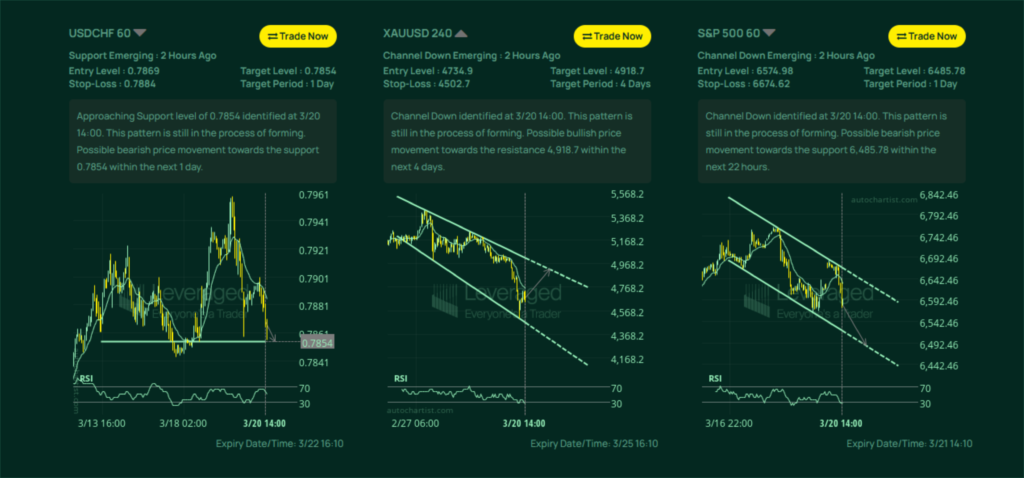
Leveraged’s AI continuously scans 50+ tradable assets across forex, indices, and commodities. In particular, it delivers:
- Real-time technical analysis across multiple timeframes (M1 to Monthly)
- Automated support/resistance identification using fractal analysis and volume clustering
- Trend strength scoring on a 0–100 scale for every instrument
- Momentum divergence detection across RSI, MACD, and Stochastic indicators
- Supply and demand zone mapping based on institutional order flow patterns
In other words, this isn’t a simple moving average crossover alert. Furthermore, the analysis engine processes hundreds of technical signals simultaneously and distills them into clear, actionable insights: “EUR/USD showing strong bearish momentum (score: 78/100), approaching demand zone at 1.0720 with RSI divergence forming on H4.” By the same token, every instrument across the platform receives this same depth of analysis.
2. Daily AI Market Insights
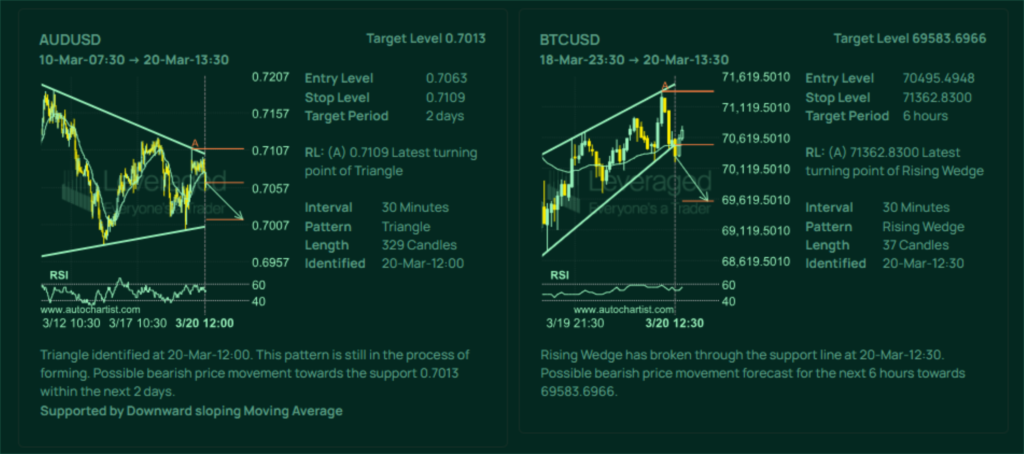
Every trading day, Leveraged delivers an AI-generated market briefing, Specifically, it covers:
- Top opportunities: The 5-10 highest-probability setups across all available instruments, ranked by confluence score
- Key levels to watch: Support, resistance, and pivot points for major instruments
- Economic calendar impact assessment: Not to mention, how upcoming news events are expected to affect each market, with historical precedent data included
- Correlation alerts: Unusual inter-market relationships that may affect open positions
- Volatility forecast: Expected price ranges for the day based on historical volatility, implied volatility (where available), and event risk
As a result, traders receive these insights prior to market open, allowing them to plan their trading day rather than react to it. On the whole, this alone gives Leveraged traders a significant head start.
3. AI-Powered Trade Journal
Most traders know they should journal – however, few do it consistently because manual journaling is tedious. Therefore, Leveraged’s AI journal automates the process:
- Automatic trade logging: Every trade is recorded with entry, exit, size, duration, and P&L
- Pattern categorization: The AI categorizes trades by strategy type, session, instrument, and market condition
- Performance attribution: Identifies which strategies, sessions, and instruments generate your profits – and which generate your losses
- Behavioral pattern detection: What’s more, it flags problematic behaviors like revenge trading (increased size after losses), overtrading (excessive trade frequency), or style drift (deviating from your plan)
- Weekly performance reports: AI-generated summaries with specific, actionable improvement recommendations
4. Risk Management AI
Managing risk is the single most important factor in prop trading success. Given that most traders fail due to poor risk management, therefore Leveraged’s risk AI provides a critical safety net:
- Real-time drawdown tracking: Visual display of how close you are to daily and overall drawdown limits
- Position size calculator: Specifically, input your stop-loss distance, and the AI calculates the exact position size to risk your target percentage
- Correlation risk alerts: Coupled with position sizing, if you hold multiple positions in correlated instruments, the AI warns you about concentrated exposure
- Drawdown velocity alerts: If you’re approaching drawdown limits faster than historical norms, the AI suggests reducing activity
- Challenge-specific risk coaching: For example, based on your challenge type (Jr., Sr., Executive), the AI adjusts recommendations. For example, with the Jr.’s 3% daily drawdown, it’s more conservative than with the Sr.’s 5%.
How Does AI Give Prop Traders a Competitive Edge?
What’s the Difference Between AI-Assisted and Manual Trading?
| Dimension | Manual Trading | AI-Assisted Trading |
| Market scanning | 30–60 minutes to review 10–15 charts | Instant analysis of 50+ instruments |
| Pattern recognition | Subjective, prone to confirmation bias | Objective, probability-based |
| News processing | Read individual articles, risk missing events | All news processed in real-time |
| Risk calculation | Manual spreadsheet or mental math | Instant, precise position sizing |
| Journal keeping | Manual entry, often skipped | Automated, always up to date |
| Emotional bias | Significant factor in decisions | AI provides objective counterbalance |
| Multi-timeframe analysis | Time-consuming to check all timeframes | Simultaneous analysis across all frames |
| Backtesting | Requires coding or manual review | Automated pattern validation |
Does AI Replace the Trader’s Decision-Making?
No – and this distinction matters. Specifically, Leveraged’s AI tools are designed to augment human judgment, not replace it.
The AI excels at:
- Processing large volumes of data quickly
- Identifying patterns without emotional bias
- Calculating risk precisely
- Maintaining consistency (it never has a bad day emotionally)
The trader excels at:
- Understanding market context and narrative
- Making judgment calls in unprecedented situations
- Adapting strategies to changing conditions
- Managing the psychological aspects of trading
Therefore, the optimal approach combines both. In other words, let AI handle data processing, scanning, and risk math, while you make the final trading decisions based on your strategy, experience, and market read. On the whole, this hybrid approach consistently outperforms either method used in isolation.
What Are the Broader AI Trends Shaping Prop Trading?
How Is the Industry Evolving with AI?
Trend 1: AI-Powered Challenge Optimization Some firms are beginning to use AI to analyze what makes traders successful in challenges and adjusting educational recommendations accordingly. Furthermore, Leveraged’s coaching system integrates AI analysis of your trading data to provide personalized improvement suggestions.
Trend 2: Real-Time Sentiment Analysis AI models now process social media, news, and forum discussions to gauge market sentiment in real time. As a result, this “crowd intelligence” signal is increasingly valuable for timing trades around major events.
Trend 3: Adaptive Risk Models Static risk rules (fixed daily drawdown, fixed max drawdown) are the standard, but AI-informed risk management is becoming more sophisticated. AI can identify when market conditions warrant extra caution – even within your standard risk parameters.
Trend 4: Personalized AI Coaching AI is beginning to serve as a 24/7 coaching tool. In particular, it analyzes your specific trading behavior, identifies your unique weaknesses, and suggests specific improvements. What’s more, this complements (but doesn’t replace) human coaching like Leveraged’s sessions with Anna Ikerte. Trend 5: Multi-Asset AI Intelligence As prop firms expand beyond forex to indices, commodities, and crypto, AI becomes essential for monitoring correlations and opportunities across asset classes. Consequently, Leveraged’s 50+ tradable instruments benefit directly from AI that can track all of them simultaneously. Not to mention, this gives multi-asset traders a significant edge.
5 AI Trends Reshaping
Prop Trading in 2026
Leveraged’s coaching system integrates AI analysis of your live trading data to produce personalised improvement suggestions, moving beyond generic advice to insight built from your actual behaviour.
This “sentiment layer” is especially valuable around high-impact news events — NFP, CPI, central bank decisions — where crowd positioning can precede price movement by minutes.
If AI detects an upcoming volatility spike or unusual correlation breakdown, it can recommend reducing position sizes proactively — not reactively after the damage is done.
This doesn’t replace expert human coaches like Leveraged’s Anna Ikerte. It amplifies them: walk into a 1-on-1 session with AI-generated performance data already in hand, and the conversation immediately becomes more specific, more actionable, and more valuable.
This is where Leveraged’s edge emerges: as a multi-asset firm, it can deploy AI across 50+ instruments simultaneously, giving traders a unified intelligence layer that single-asset competitors cannot match.
What’s Coming Next?
Looking beyond 2026, several AI developments will furthermore transform prop trading. Given these points, traders who adopt early will have the greatest advantage:
- Generative AI trading assistants that engage in conversational strategy development: “Given my recent performance, what adjustments should I make to my EUR/USD strategy?”
- Advanced anomaly detection that identifies unusual market behavior before it becomes obvious. In other words, it provides potential early warning for flash crashes, liquidity traps, or regime changes
- Sophisticated backtesting engines that can simulate strategy performance across thousands of market scenarios. Notably, this including black swan events
- AI-driven market replay for training, allowing traders to practice against historical market conditions. Equally important, AI coaching is provided in real time throughout the process.
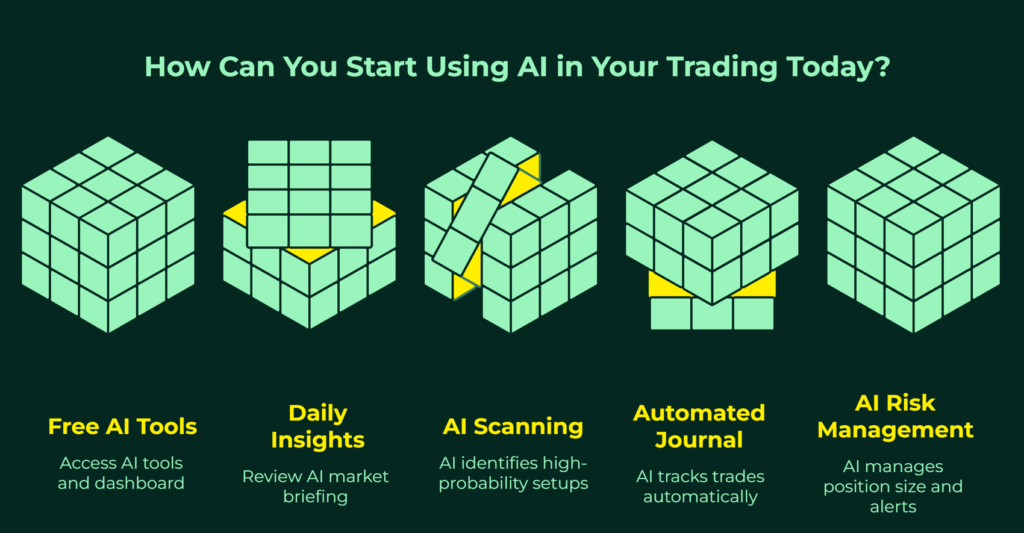
How Can You Start Using AI in Your Trading Today?
Step 1: Create a Free Leveraged Account
To begin with, sign up at Leveraged to access AI market analysis tools, daily AI insights, and the AI-powered trading dashboard.
Step 2: Use Daily AI Insights for Market Preparation
Subsequently, start each trading day by reviewing the AI-generated market briefing. Identify which instruments have the highest-probability setups and align them with your trading strategy. Prior to doing anything else each morning, this should be your first stop.
Step 3: Let AI Handle the Scanning
Instead of manually reviewing dozens of charts, use Leveraged’s AI analysis engine to scan all 50+ instruments and surface the ones that match your criteria. By doing so, you save hours of manual work every single day.
Step 4: Automate Your Journal
Furthermore, stop skipping journal entries. Let the AI journal track every trade automatically, then review the weekly performance reports for patterns you’d miss otherwise. Without doubt, consistent journaling is one of the fastest routes to improvement.
Step 5: Integrate AI Risk Management
Use the position size calculator for every trade. In addition, set up drawdown alerts and pay attention to correlation warnings. In short, let the AI be your risk management backstop. Given that most traders blow funded accounts due to risk errors, this step alone can be career-saving.
Step 6: Combine AI with Human Coaching
Finally, book a 1-on-1 session with Coach Anna Ikerte and share your AI-generated performance data. Therefore, the combination of AI analysis and expert human insight produces the most actionable improvement plans. On the whole, no other prop firm offers this level of combined support.
Frequently Asked Questions
Do I need technical skills to use Leveraged’s AI tools?
No. In fact, Leveraged’s AI tools are built into the trading dashboard with a user-friendly interface. You don’t need to code, configure models, or understand machine learning. As a result, the AI works behind the scenes and delivers insights in plain language. By and large, if you can use a smartphone, you can use these tools.
Does AI trading guarantee profits?
No. However, AI improves the quality and speed of analysis. While markets are inherently uncertain, AI gives you better information to make decisions. Nevertheless, it doesn’t make decisions for you, and no tool can guarantee profitability.
Are AI tools available during challenges?
Yes. In fact, all Leveraged AI tools – market analysis, daily insights, risk management, and journaling — are available during evaluation challenges, not just on funded accounts.
How is Leveraged’s AI different from free tools like ChatGPT for trading?
General-purpose AI like ChatGPT provides broad market knowledge. However, it lacks real-time data, specific instrument analysis, and integration with your trading account. In contrast, Leveraged’s AI is purpose-built for trading: it processes live market data, analyzes your specific instruments, and consequently provides trade-specific – not general – insights.
Is AI-assisted trading allowed by prop firms?
At Leveraged, yes. Furthermore, AI tools are integrated into the platform for all traders to use. We don’t restrict how traders use AI to improve their analysis and decision-making. However, some firms have rules against fully automated trading bots. Nevertheless, using AI as an analysis and decision-support tool is standard and encouraged.
Will AI eventually replace human traders?
For prop trading, the likely future is hybrid. Specifically, AI handles data processing, scanning, risk management, and journaling, while humans make final trading decisions, manage strategy, and handle edge cases. Therefore, the most successful traders in 2026 and beyond will be those who effectively combine AI tools with human judgment.
The AI-First Advantage
The prop trading industry is splitting into two categories: firms that integrate AI into the trader experience, and firms that don’t. Consequently, Leveraged is firmly in the first category – not because AI is trendy, but because it measurably improves trader outcomes. Specifically, better analysis leads to better trades, while disciplined risk management prevents blown trading accounts. Ultimately, consistent journaling is what paves the way for faster improvement. And all of it together leads to more funded traders receiving more bi-weekly payouts. That’s not hype. That’s the math. Create your free Leveraged account and experience AI-powered trading →
This article is part of Leveraged’s Trader Education Hub. Continue exploring our Complete Guide to Prop Trading, Challenge Comparison Guide, and Free Trading Resources.