


The Complete Guide to Prop Trading in 2026
Proprietary (prop) trading lets you trade financial markets using a firm’s capital instead of your own money. In 2026, the prop trading industry is worth an estimated $20 billion globally, with over 2,000 firms funding skilled traders worldwide. Through an evaluation challenge — where you prove your skills on a demo account — you can earn access to funded accounts ranging from $10,000 to $1,000,000, keeping up to 80–95% of your profits. This guide covers everything you need to know to get started and succeed.
What Is Proprietary Trading and How Does It Work?
Proprietary trading — commonly called “prop trading” — is a model where a financial firm provides capital to traders. Instead of risking your own savings, you trade with the firm’s money and split the profits. The modern prop trading model works in three stages:
- Evaluation (Challenge): You purchase access to a simulated trading challenge. The firm sets profit targets, drawdown limits, and trading rules you must follow. This proves you can trade profitably while managing risk.
- Verification: Some firms add a second (or third) phase to confirm your results weren’t a fluke. Targets are typically lower in verification phases.
- Funded Account: Once you pass, you receive a live funded account. You trade real capital, and the firm pays you a percentage of profits — typically 80% or more.
This model solves the biggest barrier in trading: capital. A skilled trader with a $500 personal account has limited earning potential. That same trader with a $200,000 funded account can generate meaningful income while the firm shares in the upside.
How Big Is the Prop Trading Industry?
The industry has grown from a niche corner of finance into a legitimate pathway for retail traders to access institutional-level capital. The numbers tell a compelling story:
- $20 billion estimated global industry value in 2026
- 2,000+ prop firms operating worldwide (62% based in the US)
- 607% growth in search interest for prop firms between 2020 and 2024
- Over $1 billion paid out collectively by top prop firms
- 150+ countries with active funded traders
Value
Firms Worldwide
Growth 2020–2024
Traders Collectively
Active Funded Traders
Receive a Payout
Who Is Prop Trading For?
Prop trading attracts a wide range of participants. You might be a good fit if you are:
- A skilled trader lacking capital. You have a profitable strategy but don’t have $50,000–$100,000 to trade with meaningful position sizes.
- A developing trader seeking structure. Challenge rules force discipline — maximum drawdowns, daily loss limits, and profit targets create a framework that many traders need.
- A career changer. Prop trading offers a pathway to full-time trading income without quitting your job first. Start with an evaluation during evenings and weekends.
- An experienced trader wanting to scale. If you’re profitable on a $5,000 account, scaling to $200,000 or even $1,000,000 in funded capital multiplies your returns.
- Someone in a developing market. Prop firms operate globally. Traders in over 150 countries access the same funding opportunities, making this one of the most geographically democratic income paths available.
You don’t need a finance degree, a specific certification, or years of institutional experience. What you need is a demonstrable ability to trade profitably while managing risk.
Watch how Rosemon approached his first prop firm experience and passed the Turbo Challenge.
See how Kevin bounced back after getting scammed and became funded within a year.
Watch how Danny made one key change to finally get funded and paid.
How Do Prop Firm Challenges Work?
The evaluation challenge is the gateway to funded trading. While each firm structures challenges differently, the core mechanics are consistent.
What Are the Key Challenge Parameters?
| Parameter | What It Means | Typical Range |
|---|---|---|
| Profit Target | The return you must generate to pass | 5%–10% per phase |
| Maximum Drawdown | The total loss threshold that fails you | 6%–12% of account |
| Daily Loss Limit | Maximum you can lose in a single day | 3%–5% of account |
| Time Limit | How long you have to reach the target | 30 days to unlimited |
| Minimum Trading Days | Required active trading days | 0–10 days |
| Leverage | Buying power multiplier | 1:10 to 1:100 |
| Number of Phases | How many evaluation stages | 1–3 phases |
What Are Common Challenge Structures?
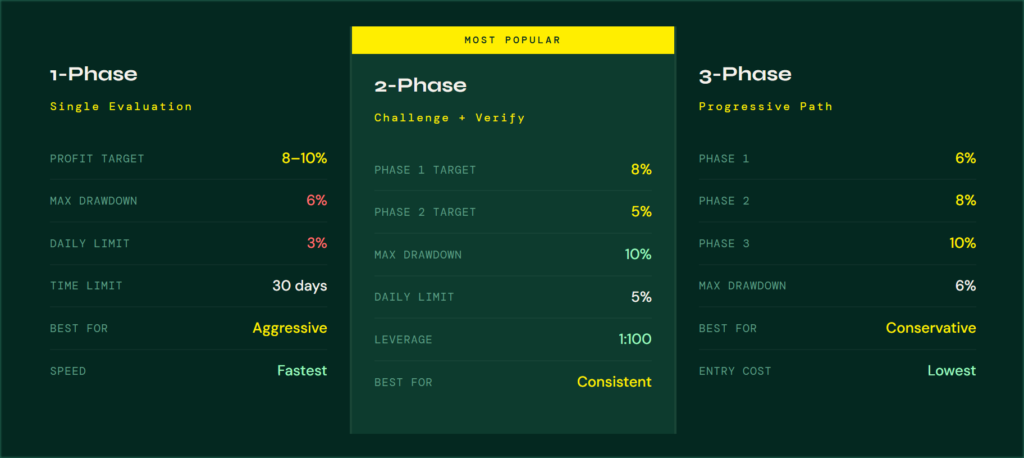
One-Phase Challenges require you to hit a single profit target (often 8–10%) within one evaluation period. These are faster but typically have tighter drawdown limits. Two-Phase Challenges split evaluation into a Challenge phase (higher target, e.g. 8%) and a Verification phase (lower target, e.g. 5%). This structure gives firms more confidence in your consistency. Three-Phase Challenges add a third evaluation layer, often with progressive targets. While they take longer, they may offer more favorable drawdown rules or lower entry costs. At Leveraged, we offer all three structures so traders can pick the path that matches their style:
- Jr. Portfolio Manager — 1-phase, 10% target, 3%/6% drawdown, 1:30 leverage
- Sr. Portfolio Manager — 2-phase, 5%/8% targets, 5%/10% drawdown, 1:100 leverage
- Executive Portfolio Manager — 3-phase, 6%/8%/10% targets, 3%/6% drawdown, 1:30 leverage
We also offer Turbo (Pay After You Pass) starting at just $8.88 and Sprint, a fast-track challenge for confident traders.
What Risk Management Rules Do Prop Firms Enforce?
Risk management isn’t just a suggestion in prop trading — it’s enforced through hard rules. Breaking these rules results in immediate disqualification, regardless of your overall profit.
What Are the Most Common Risk Rules?
Maximum Drawdown (Overall Loss Limit): If your account drops below a set threshold from your starting balance (or highest recorded balance, in the case of trailing drawdown), you fail. Example: On a $100,000 account with 10% max drawdown, your equity cannot fall below $90,000. Daily Loss Limit: Your losses on any single calendar day cannot exceed a set percentage. This prevents one bad day from destroying an otherwise strong evaluation. Leverage Limits: Firms cap how much buying power you can use. Higher leverage means larger positions but also faster drawdowns. Most firms offer between 1:10 and 1:100 leverage. Prohibited Strategies: Some firms restrict high-frequency trading, news trading, martingale strategies, or weekend holding. Always read the rules before starting.
Why Do Risk Rules Actually Help You?
Counterintuitively, strict risk rules are one of the greatest benefits of prop trading. They force you to:
- Size positions appropriately
- Use stop-losses consistently
- Avoid revenge trading after losses
- Think in terms of risk-reward ratios
Many traders report that their personal trading improves dramatically after going through prop firm challenges, precisely because the rules instill professional habits.
How Do You Choose the Right Prop Trading Firm?
With over 2,000 firms in the market, choosing wisely matters. Here’s what to evaluate:
What Should You Compare Between Prop Firms?
| Factor | What to Look For | Red Flags |
|---|---|---|
| Profit Split | 80%+ is standard; some offer up to 95% | Below 70% |
| Payout Frequency | Bi-weekly or weekly is ideal | Monthly only or vague timelines |
| Challenge Pricing | Reasonable fees relative to account size | Hidden fees or upsells |
| Drawdown Type | Static drawdown is more trader-friendly | Trailing drawdown from day one |
| Time Limits | No time limits reduce pressure | Very short deadlines |
| Leverage | Matches your strategy’s needs | Extremely low or undisclosed |
| Educational Support | Free courses, coaching, webinars | No support at all |
| Tradable Assets | 50+ instruments across forex, indices, commodities | Very limited selection |
| Technology | AI tools, modern dashboard, mobile access | Outdated platforms |
| Track Record | Verified payouts, real reviews, established history | No payout proof |
| Customer Support | 24/7, responsive | Slow or non-existent |
Why Does Educational Support Matter?
The prop trading industry’s pass rate sits between 5% and 15%, with only about 7% of all traders ever reaching a payout. Firms that invest in trader education – through coaching, courses, webinars, and AI-powered analysis – directly improve your odds of success. At Leveraged, we provide:
- Free trading courses covering technical analysis, risk management, and strategy development
- Daily webinars with live market analysis
- 1-on-1 coaching with Head Coach Anna Ikerte (10+ years of trading experience)
- AI-powered trading tools that analyze market conditions in real time
- A trader community for peer support and collaboration
- 50+ tradable assets across forex, indices, and commodities
How Do You Get Funded and Start Earning?
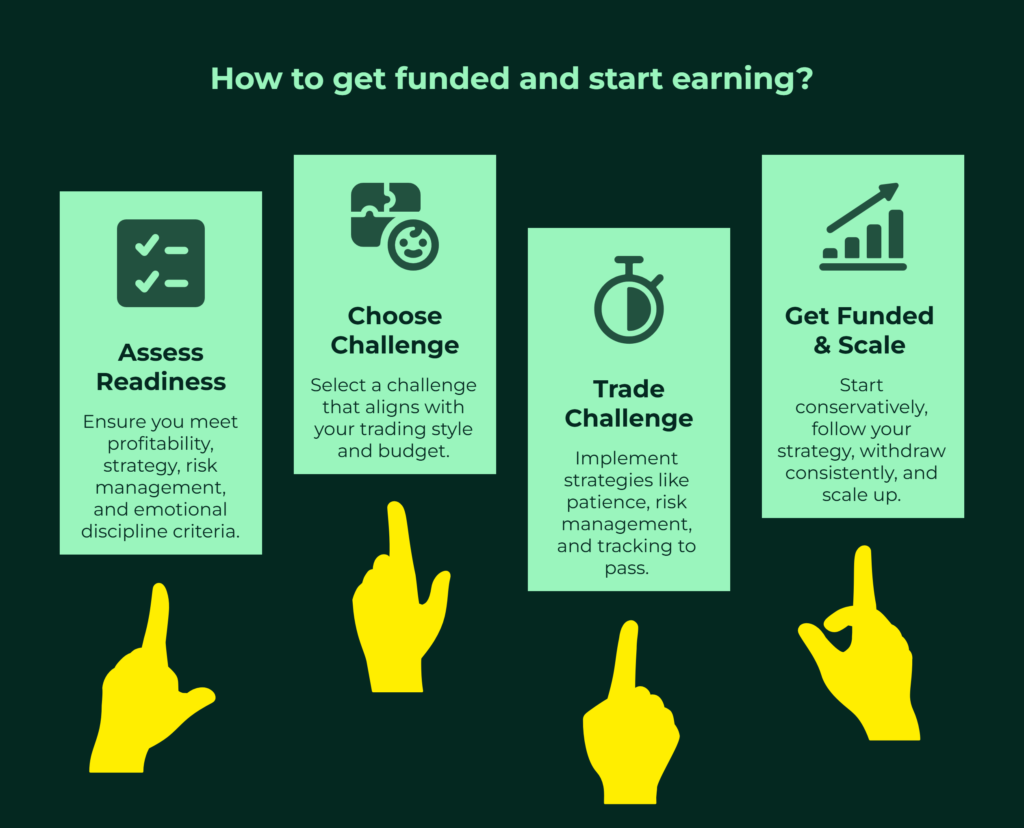
Getting from zero to funded follows a clear path:
Step 1: Assess Your Readiness
Before paying for a challenge, ask yourself:
- Can I demonstrate consistent profitability over 30+ trades?
- Do I have a defined strategy with clear entry/exit rules?
- Can I manage risk within 3–5% daily drawdown limits?
- Am I emotionally disciplined enough to follow rules under pressure?
If the answer to any of these is “not yet,” invest time in a demo account first. Leveraged’s free courses and coaching can accelerate your preparation.
Step 2: Choose Your Challenge
Match the challenge to your trading style:
- Aggressive traders with high win rates may prefer 1-phase challenges (higher targets, faster completion)
- Consistent traders with moderate returns may prefer 2-phase challenges (lower per-phase targets, more room for drawdown)
- Conservative traders may prefer 3-phase challenges (progressive targets, structured advancement)
- Budget-conscious traders should look at pay-after-you-pass models like Leveraged’s Turbo starting at $8.88
Step 3: Trade the Challenge
Key strategies for passing:
- Don’t rush. If there’s no time limit, use it. Patience reduces forced trades.
- Risk 1–2% per trade. This gives you 30–50 trades before hitting drawdown limits.
- Trade your strategy, not the target. Chasing profits leads to overleveraging.
- Track everything. Use a trading journal to identify patterns in your performance.
- Use available tools. AI analysis, market insights, and coaching sessions can provide edge.
Step 4: Get Funded and Scale
Once funded:
- Start conservatively. Protect your funded account in the first weeks.
- Follow the same strategy that passed your challenge.
- Withdraw consistently. Bi-weekly payouts (like Leveraged offers) let you build income steadily.
- Scale up. Most firms, including Leveraged, offer scaling plans up to $1,000,000 in funded capital.
What Is the Future of Prop Trading?
The prop trading industry is evolving rapidly. Several trends are shaping 2026 and beyond:
How Is AI Changing Prop Trading?
Artificial intelligence is becoming central to the trading process. AI-powered tools now offer:
- Real-time market analysis that processes thousands of data points per second
- Pattern recognition across multiple timeframes and instruments
- Risk assessment that identifies overexposure before it becomes a problem
- Trade journaling that automatically categorizes and analyzes your performance
Leveraged is positioning as an AI-first prop firm, integrating AI analysis directly into the trader dashboard and providing daily AI-generated market insights.
What Other Trends Are Shaping the Industry?
- Lower barriers to entry. Pay-after-you-pass models and challenges starting under $10 are making prop trading accessible to everyone.
- Faster payouts. The industry is moving from monthly to bi-weekly to weekly payouts.
- Better education. Top firms now offer comprehensive learning ecosystems, not just capital.
- Global expansion. Prop firms are reaching traders in 150+ countries, with localized support and payment methods.
- Regulatory attention. As the industry matures, expect clearer regulatory frameworks that protect traders and legitimize reputable firms.
- Multi-asset expansion. Beyond forex, traders now access indices, commodities, crypto, and stocks through prop firms.
Frequently Asked Questions About Prop Trading
How much money do I need to start prop trading?
Challenge fees typically range from $39 to $1,000+ depending on the account size. Some firms, like Leveraged, offer pay-after-you-pass models starting at $8.88, meaning you only pay if you successfully complete the challenge. You don’t need trading capital — the firm provides that.
What percentage of traders pass prop firm challenges?
Industry-wide, approximately 5–15% of traders pass evaluation challenges, and only about 7% ever receive a payout. However, traders who invest in education, practice on demo accounts, and use available tools (AI analysis, coaching) significantly improve their odds.
How much can I earn as a funded trader?
Earnings depend on your account size, profit split, and trading performance. With an 80% profit split on a $200,000 account, generating a 5% monthly return would yield $8,000/month. Scaling to $1,000,000 with the same performance yields $40,000/month.
Earnings Calculator: What Could You Make?
Is prop trading legitimate?
Yes. Established prop firms like Leveraged, FTMO, and others have collectively paid out over $1 billion to traders. Look for firms with verified payout records, transparent rules, responsive support, and a track record of at least 1–2 years.
Do I need experience to start prop trading?
While experience helps, it isn’t strictly required. Many successful funded traders started as complete beginners who dedicated time to learning. Leveraged offers free courses, daily webinars, and 1-on-1 coaching to help traders at every level.
What markets can I trade with a prop firm?
Most prop firms focus on forex, but many (including Leveraged) offer 50+ tradable assets including major and minor forex pairs, indices like S&P 500 and NASDAQ, commodities like gold and oil, and more.
What happens if I fail a challenge?
If you breach a drawdown rule or fail to hit the profit target, you can typically repurchase the challenge (often at a discount) and try again. Many firms offer free retries under certain conditions. The key is to analyze what went wrong, adjust your approach, and try again with better preparation.
Can I trade prop firm challenges part-time?
Absolutely. Many prop firms, including Leveraged, have no time limits on their challenges. This means you can trade around a full-time job, family commitments, or other responsibilities. Trade when conditions are right — not when a deadline forces you to.
Start Your Prop Trading Journey Today
The prop trading industry has never been more accessible. With firms like Leveraged offering funded accounts up to $1,000,000, an 80% profit split, no time limits, free education, AI-powered tools, and coaching from experienced professionals — the only thing between you and a funded trading career is proving your skills. Create your free Leveraged account and choose your challenge →
This guide is part of Leveraged’s Trader Education Hub. For more in-depth content, explore our challenge comparison guide, free trading courses, and AI trading tools overview.